


Windy Arbour
Once, many years ago, I lived out in the country in Lancashire, at a school in Cockerham. I’ve written elsewhere about the school and the fact that it was once the house where Leonora Carrington had lived as a child. I’ve included some background about her and the school below.
It’s wild country round there, between the sea and the fells, overlooking Morecambe Bay with its nuclear power station and treacherous sands, and the point where slaves were once landed. It’s the kind of place where Andrew Michael Hurley sets his strange, unsettling books. There’s a website dedicated to Cockerham’s history and there you’ll find mention of ‘Windy Arbour’.
Near where I was living, a canal passed by an old, ruined cottage with that name. In the field beside it, where we used to go coursing, there was the trace of a Roman road. On an autumn evening, when the sun lay flat across the grass, you could still make out the shadow of where a way used to be. Hares and rabbits might run across it now and sheep sleep on it, but that old road lingered.
A tramp lived at the cottage. He would stay there at night after wandering through the fields by day, collecting scraps of metal and bits of dry wood. Nobody really knew who the tramp was or where he came from. The farmer’s wives called him Jasper, but that was just a joke. Most of us simply nodded our heads to him, except Jen, the barmaid at The Manor, who for the sake of politeness always called him Mr Stephen, the name she said he had first given her.
I’ll call him Stephen.
Stephen originally came from down south somewhere. When he was in the Manor, he would start muttering ‘Carry on London. Carry on’. But nobody took much notice. It was simply the signal that Stephen was getting drunk. Most of the money he earned from selling scrap metal or bundles of firewood he spent on the dark brown ales he drank from a sherry glass.
And that’s about the most anyone knew about Stephen. There was a rumour that during the war, he’d lost most of his company during a battle and he had never recovered. It might be true.
One night when I went up to the Manor for a couple of beers, I was surprised to see that Stephen wasn’t in his usual seat next to the fruit machine. Later, after talking it over with the Jen, I decided to walk down the lane to the ruined cottage to see if he was all right. When I got there, was no sign of him. I presumed he had simply changed his drinking habits and had gone to another pub. He had been known to do that in the past. I thought no more about it.
The next evening, I went up to the Manor again, and Stephen was back in his usual place.
I nodded to him. ‘Didn’t fancy our company last night then, eh?’
He glanced up from his drink and looked me in the eye for a moment. His face was white. He closed his eyes and sank back in his seat.
‘Mr Stephen had a bit of bad news last night, didn’t you love?’ said Jen.
Stephen remained silent, said nothing and Jen rubbed a finger near her temples with a knowing look on her face.
‘Shame,’ she murmured.
I sat down next to Stephen. We didn’t speak, but occasionally he would turn to me, and his mouth would open, then close. Later on, he walked out unsteadily, muttering, taking a bottle of beer with him. As he hurried through the door he looked back at me. There was no expression in his pale face.
‘Bugger it’, he muttered and was gone.
I left the pub at about eleven. There was no moon that night, but the stars were bright and the air cold and clear. As I passed the field at the end of the road, something startled me. It wasn’t a noise, more a lack of sound, a stillness. I stopped and scanned the field. I thought I saw Stephen, far down the road away from me near the brook. He seemed to be running along the edge of the wood, a shadow in and out of shadow. There was no sound of his movement, a silent form of rushing darkness. He disappeared into the wood, and I lost him.
I walked home puzzled.
I met him out in the fields a couple of days later. He looked haggard and sick. As usual he was wearing his greasy old raincoat, and he carried a white shopping bag full of old newspapers and some bits and pieces of rusty metal. I walked with him to the road, passing the time of day. He called me Dud or Dudley, because he knew where I came from, and when we reached the roadside he said quietly, ‘Don’t go Dud.’
‘No,’ I replied, ‘All right.’
In the following minutes of silence, I pulled myself up onto a gate and sat there, elbows on knees. Stephen bent over his bag, shuffling his papers. He would stop now and then and look towards the canal, or towards the woods where I had seen him a few nights before. He pulled a piece of newspaper from his bag and held it out to me. I understood I should read it.
It was cutting torn from the Willesden Gazette, dated October 31st 1947. On it were some lines of verse.
The Tinker’s Tale
by Stefan Gosvitch.
I’ll begin my tale, the old man said
a fag in his fingers as he scratched his head
It’s a tale that’s true, though some may say
I invented the story when I was bored one day.
It all concerns a friend of mine,
a lad named Tom with half a mind
He lived with his dad on a ramshackle farm
He was a quiet lad, never did any harm
But his father hated him very much
If he got in his way he’d give him a cuff.
And he wasn’t looked after very well
His dad often said he could go to hell
for all he cared, & that wasn’t much
So poor Tom had a pretty bad life
& he stood no chance of getting a wife
his only joy was when he came for a drink
he’d knock ‘em back as quick as you blink
Well time went on and Tom began
to get a bit nasty about his old man.
His dad started treating him like a cur
Tom was spoiling to do him a hurt.
Some nights I’d see him with a look in his eye
he’d say he’d get even by and by.
Sure enough that very night
Tom reached his limit and started a fight.
He stabbed his dad with a kitchen knife
And very soon after took his own life.
Well things went quiet on the farm for a while.
The police came down and opened a file,
Closed it soon after, an open and shut case,
But it was opened after a few days….
That was all. The paper was roughly torn at the last line.
‘Did you write this, Stephen?’ I asked but received no reply.
He held his hand up when I went to give him back the cutting.
‘What was your bad news?’ I asked him.
‘Can’t sell the metal.’
He picked up his bag and wandered off along the grass verge keeping close to the hedge. He never looked back. I watched him walk away up the hill. His silvery head bent, his bag swinging against his raincoat, flapping around him as he walked. Near the top of the hill, just below the canal bridge, a crow flew up from the other side of the hedge and lay in the air above the sweep of grass.
It was my birthday. There was a big party at the pub that night and I got pretty drunk. Afterwards I couldn’t sleep and spent a long time prowling round my room. I stood at my window watching the mist thicken across the land. I went out walking in a freezing fog. A deep frost on the ground and in the trees. All the colour had drained from the countryside around me. My ears and eyes ached from the biting cold.
I stopped for a moment to get my bearings, unsure of how far I had walked, but I was sobering up. I was making my way back along the canal when I heard a faint voice drift through the icy air.
‘Dudleee…..’
I stopped by the canal bridge and listened, peering into the mist.
I felt uneasy. There was a bleak moment of eerie quiet.
With a crash of branches giving way and breaking, something pale and heavy fell out of the silence through the trees. It dropped like a gravestone and struck the thin veil of ice on the canal’s dark surface. It was so close to me so that I could smell it falling, rank and sour.
It didn’t move, except as it heaved up and down by the effect of its own descent on the water. It was the corpse of a great white bird, a swan, that lay now in the water, one wing outstretched and its head submerged.
I felt sick with shock. I cursed the dead bird in the broken water.
I stumbled up to the road. Stephen was running towards me along the lane from the cottage as best he could. He met me in the darkness. He dragged me into a field and pushed me down to crouch below the hedge in a tangle of thorn. I begged him to explain but he stood in silence, watching, his hand on my shoulder holding me down.
He was staring at the wood, his mouth open, breathing hard, his white face strained with tension.
A wind had come up and was tearing the grass.
The trees of the wood swayed and twisted like a mass of moving arms.
The speck of golden light came out of the wood. It was but a speck, a tiny speck that grew in the wood itself like a flame. The wood gave birth to this light; it came from the heart of the trees.
“See, see!” Stephen shook me.
The speck of light expanded, became a flower of light, and the flower a shield, which then burst in brilliance, filling the trees, surrounding us, a great golden glow, and beyond it, an unseeable world of black.
The sheer light bathed us and bathed us in silence. There was no sound, no sound at all.
We looked into the heart of light, the silence. I was petrified. I felt naked, I could not see, I could do nothing. I was impotent, my mind at its limit. Yet somehow I knew that this was just a beginning.
The earth began to retch and buckle.
The stretch of grass before us moved unevenly, the sods broke up, turned over, and the crumbling soil beneath came up. Worms, slugs, and insects crawled and writhed and twisted among the clumps of earth. Stephen dropped to his knees beside me. I fell forwards clutching the writhing soil, scraping a noise from my throat.
‘Stop. Stop.’
But the long dead were rising. The light began to fade, to drain underground, sinking into the upturned earth. And as darkness closed around us once more, the scalding noise of a thousand squealing beings burst out of the air. I breathed the noise. Panic-stricken, we ran to hide from it, flinching from its pain. I tried to escape, but was caught in the hedge, and tore my face and hands in a scramble of thorns. I fell, legs twisted, and watched in terror.
The noise intensified, whining, screeching, metal on metal. The light had pooled as it seeped away into the earth. Then it rose, like a slab lifted from a tomb. It shimmered and a human form began to emerge, the spectre of a man, dripping with liquid light that splashed to the ground, to be absorbed by the earth.
One side of his body was whole, but the other side, from eye socket to groin, was alive with maggots and insects. They seethed around the head of a broken spear, stuck fast in his ribs. Clutching at it, his hands were broken and twisted. His one eye was white. He looked blindly towards us.
Behind him, indistinct, vaporous, there lay other men, some as skeletons. Beyond them a troop of corpses carried their own heads. Others clutched swords or spears that pierced their bodies through. Their hands were drenched in blood. Some had no eyes, but worms writhed in the sockets. The noise that addled my brain was their noise. And the light and the darkness were theirs and out of that noise, as it screeched and screamed its loudest, came words, words I felt within me.
Send a messenger.
That we are the men of the wall.
Here is the end of the road.
We cannot hold.
Here is the end of the way.
Guard well the land.
The words trailed away. The noises faded as the spectres seeped back into the land. The golden light dwindled, flickered, sank.
I was terribly cold. I stared at the wood, at the grass, at Stephen. I made myself go to him and held his head in my arms, held him as tightly as I could.
His face was the face of the ghostly soldier.
‘Bugger it,’ he breathed, and his eyes stared up at broken branches and the grey, dawn cloud beyond.
I knew he was dead. I lay beside him and cried for him, shaking uncontrollably.
I spent a lot of time with the police, stayed in the cells. They never believed what I told them. Stephen died of a heart attack after we’d been out drinking. The police told me his name was Thomas Greenwood, an old soldier, he had been parachuted from a glider over Arnhem but took a bayonet in the chest and had been taken prisoner.
When had I first met him, really, they wanted to know. Why did I have such influence over him? People blame me for his death, accuse me of taking an old man out poaching when he wasn’t fit on a bad night. Worse, that I killed him when I was drunk and out of my mind. I think that’s what most people believe.
I was in a secure hospital for a while. I was told I had a personality disorder. It was a long time before I came back here. People don’t talk to me much, and I never go to the pub.
I’ve be working as a volunteer on the archaeological dig in the field near the canal. I was reading the paper yesterday and there was a short article about recent discoveries made here. I cut it out.
According to the professor quoted in the article, a chap I had seen on the dig wearing a woolly balaclava, the Roman road here was never finished. It doesn’t go anywhere. And near the spot where the Roman road petered out, they’ve found what are probably weapons and tools of the men who were building the road. They also found a skeleton, with a bronze spearhead stuck in its ribs.*
From I’ve looked at clouds, A Patch of Sky May 21st 2024
I had a part-time job for my last two years at university, working as a child-care assistant at a dark Victorian pile called Crookhey Hall School, at Cockerham in Lancashire. It was a Liverpool Education Authority residential school for what were then called (!!) ‘Educationally Sub-normal Children’ (!!) This was a catch all for a group of Liverpudlian boys aged between 4 and 15 who ranged from born naturalists who had played truant too often hunting birds nests or field mice, to expert car thieves; from youngsters with autism and learning difficulties, to teens with mental health problems. With such a diverse group, the staff, both teachers and care workers, did an amazing job. Mine was simply to be around two or three evenings a week to make sure they got to bed and settled down. And didn’t abscond. Most of the boys thought they were imprisoned at Stalag Luft III and felt it their moral duty to escape. Some did, only to be brought back to the school by the local plods, who found them wet and cold, sheltering on the moss.
Schemes
I was reminded of the school (in a stark contrast - both sides, now) when I read last week that a painting by Leonora Carrington has been sold for a record price of $28.5 million. That dark Victorian pile, Crookhey Hall, was the house where Leonora Carrington grew up.
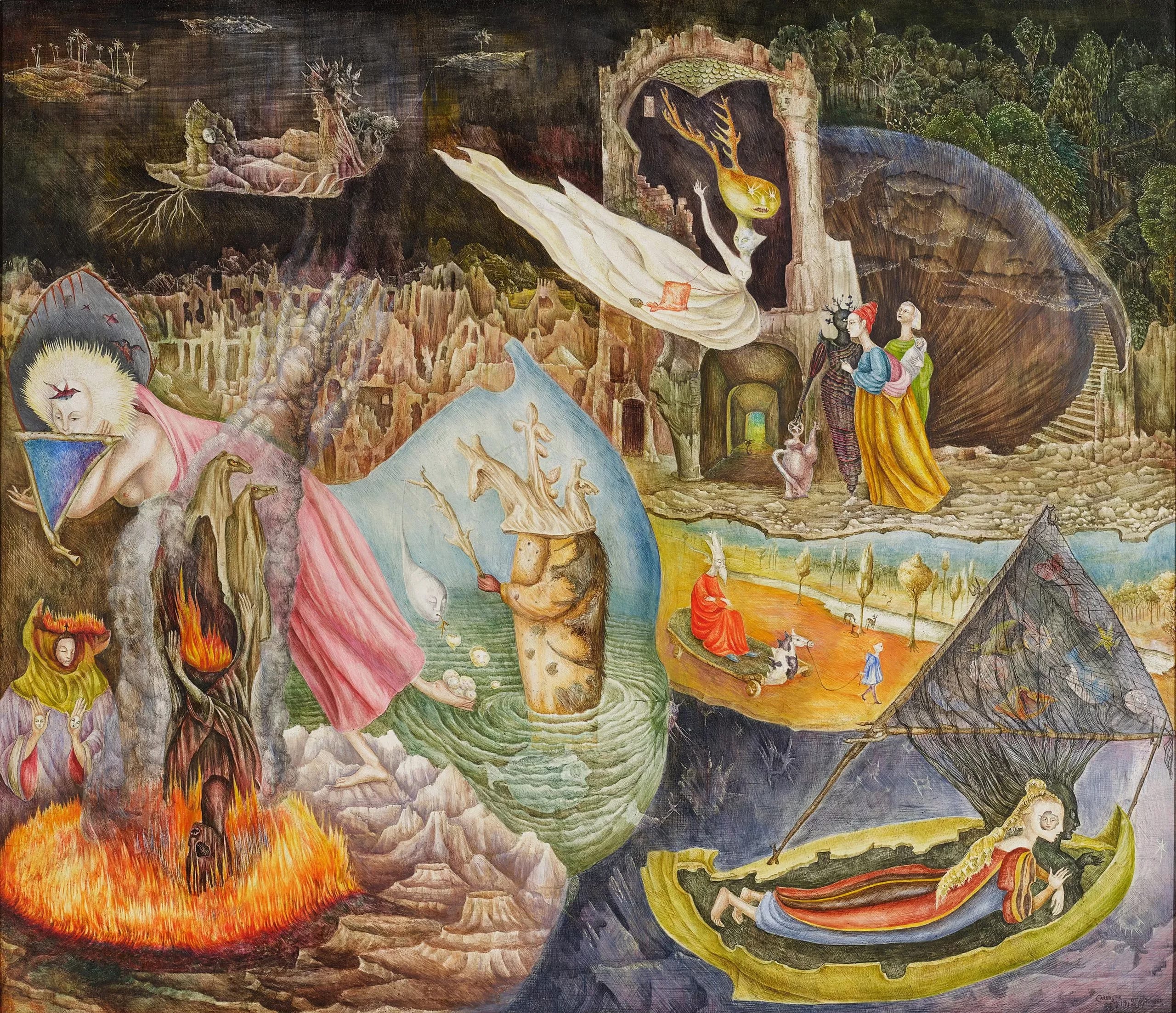
The painting which Sotheby’s sold for the record price was Les Distractions de Dagobert, painted by Carrington in 1945. Although Carrington painted Les Distractions de Dagobert soon after moving to Mexico City, for me it, and much of her other work, is full of echoes of Lancashire legends, beings and motifs, boggarts and will o' the wisps, ghosts and shape-shifters, fairies and witches. 'It’s a chaotic yet beautiful painting, bursting with imagery on every inch of the canvas,' writes Aimee Ferrier.
*I wrote the first draft of Windy Arbour at Crookhey Hall when I worked at the school in 1973. It was one of the first short stories I ever wrote and I read it out to the boys in one of the dormitories as a bedtime story to try it out.
With very best wishes for Christmas and the New Year. Have a great time!