

It’s making me ill...
Adventures on a hypnopompic threshold (with acknowledgments to Dorothy Lehane)

My problem
In a recent Note, I mentioned that I find the very final stages of editing especially difficult. Accepting that a work is never really finished but let loose to survive in the wild after our careful nurturing, I feel I know when I've reached the limit of my process. Wiser and more experienced practitioners may have techniques to help them reach release point, like trusting the trained hawk on the wrist, but I know when I'm as close to completion as I'll ever be.
This time the process has synchronised with my feeling unwell, and the complexities and delicacies of final editing appear to map onto my dis-ease.
I've been wrangling an assortment of partially trained animals, aspects of my story that haven't settled yet. I've received insightful feedback from my trial readers and certainly some of these comments have spooked the horses, if my story elements can be compared to a group of lairy colts.
Editing ailments
My work of creative non-fiction is a 'non-fiction novel' as John Naughton recently described the superb work When we cease to understand the world by Benjamin Labatut, which I’ve read with great pleasure and admiration.
Almost all my readers felt they would like me to insert the author, i.e. a version of myself, more into the story, which many felt is a defining characteristic of creative non-fiction. Think of Wifedom by Anna Funder and Blackouts by Justin Torres (which I have also read) or In the Dream House by Carmen Maria Machado or Your Little Matter by Maria Grazia Caladrone (which I haven’t).
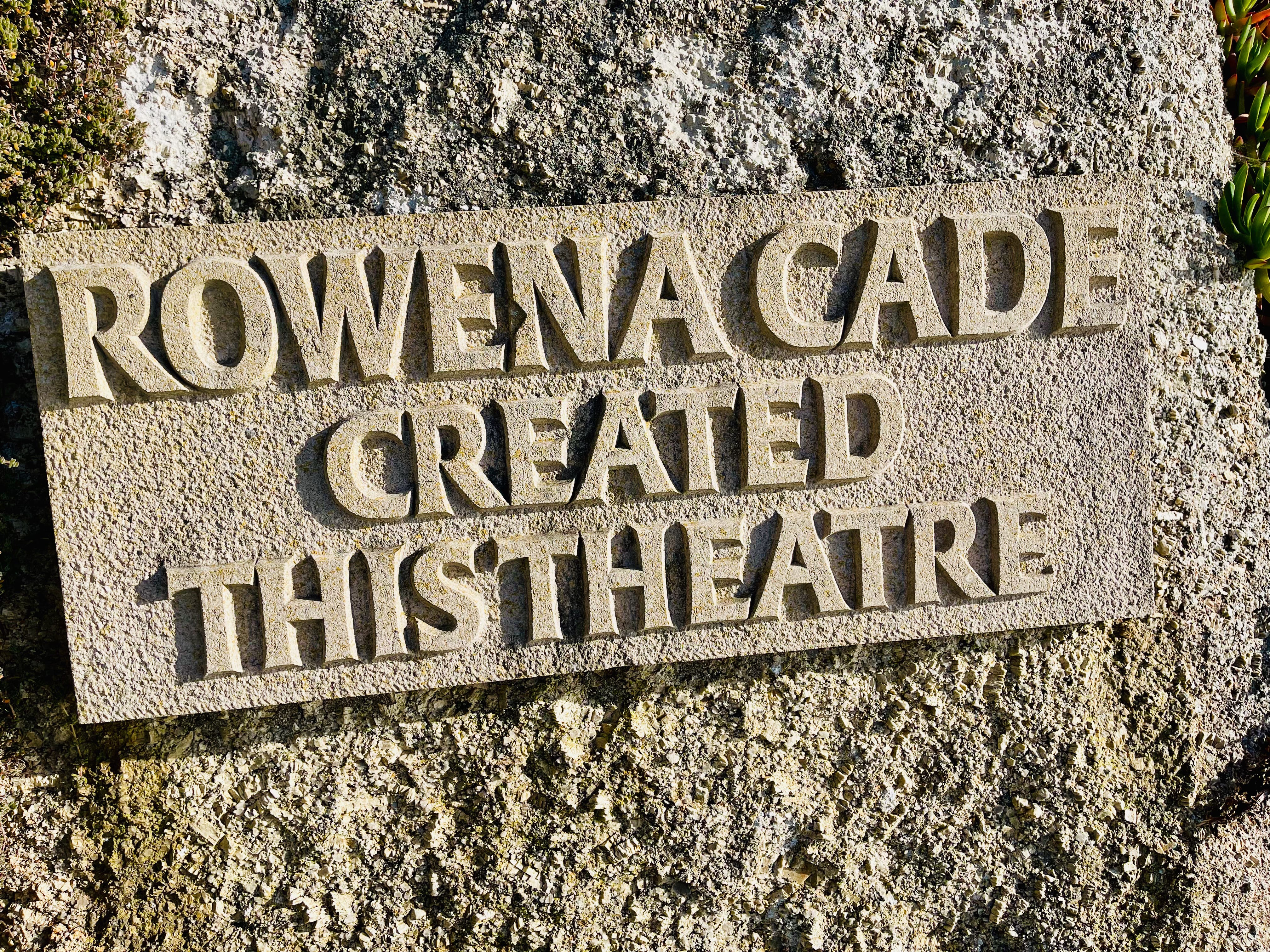
But as my work is about a woman, Rowena Cade, and the theatre she built, The Minack Theatre in Cornwall, I have shaped the story as a dramatic five act structure. In other words, even though I’ve written in novelistic prose, I haven't used chapters but the traditional separations, acts and scenes, of a stage play.
Sections where I have introduced myself, my research, my feelings and my process have been restricted to entr'actes between each act. But, in spite of trying various optional solutions to add more of my involvement, none were working efficiently or in any way satisfactorily. The entr’actes felt clumsy and forced.
Cue a tummy ache and acute gastritis to echo this tangle of structure and desire.
Next, I realise I'm still not 'slowing down' enough, as one tutor on my MA (the wonderful Julia Bell) constantly encouraged me to do. I'm not writing a film script so I need to provide more evocative detail to create a more fulfilling experience for the reader.
Cue restless legs and twitchy arms, not helped by being up to my elbows in angry nettle stings and thorn pricks after picking blackberries. The berry harvesting did provide a welcome opportunity to put my mind into neutral through a repetitive activity. That was until the nettles and briars provided spiky reminders.
At present, the end of the story peters out to be followed by a series of appendices, notes logging research experiences. Almost all my readers agree these should be carefully kneaded back into the main narrative. It’s a request which neatly loops back to the problem of structure too.
Cue my sleepless tossing and turning at night and a severe pain in the neck. With added reflux.
Finally a common request was for more information about how Rowena and her gardener, Billy Rawlings, built the theatre through its continued evolution.
Cue my body’s response involving arthritic wrists and fingers, which no doubt Billy and Rowena suffered from working on the exposed cliff in all weathers in their sixties and seventies.
It became very obvious over the last week that a cure needed to be found for these various ailments of my story and my body.
This is where we step over the wonderfully named hypnopompic1 threshold. As I drifted in and out of sleep last night after much tossing and turning and all the aforementioned bodily discomforts, I seemed to lurch back and forth hymnopompically, and as I did so, ideas for effective treatment began to emerge.2

Psychopomping
But I’m going to take a short break here to introduce another sort of pomp. The psychopomp.
In Jungian psychology, the psychopomp is a mediator between the unconscious and conscious realms. It is symbolically personified in dreams as a wise man or woman, or sometimes as a helpful beast. I guess a psychopomp can be seen as the gatekeeper of the hypnopompic threshold.
Originally psychopomps were all kinds of life forms in many different belief systems whose had the job of escorting the souls of the dead to the afterlife.
The word is derived from the Greek word psychopompós, literally meaning the ‘guide of souls’.
Hermes was a psychopomp, meaning he brought newly-dead souls to the underworld, Hades. He also brought dreams to living mortals.
‘Christian writers considered Hermes Trismegistus to be a wise pagan prophet who foresaw the coming of Christianity. They believed in the existence of a prisca theologia, a single, true theology that threads through all religions. It was given by God to man in antiquity and passed through a series of prophets, which included Zoroaster and Plato.’
Psychopomps have been depicted at different times and in different cultures as anthropomorphic entities, most popularly as birds – ravens, crows, vultures, owls, sparrows, and cuckoos – but also as horses, deer, dogs and other animals.
A shaman may also fulfil the role of the psychopomp. The ‘end of life doula’ is a contemporary psychopompic role.3
Hermes was a psychopomp, meaning he brought newly-dead souls to Hades. He also brought dreams to living mortals.
‘Christian writers considered Hermes Trismegistus to be a wise pagan prophet who foresaw the coming of Christianity. They believed in the existence of a prisca theologia, a single, true theology that threads through all religions. It was given by God to man in antiquity and passed through a series of prophets, which included Zoroaster and Plato.’4
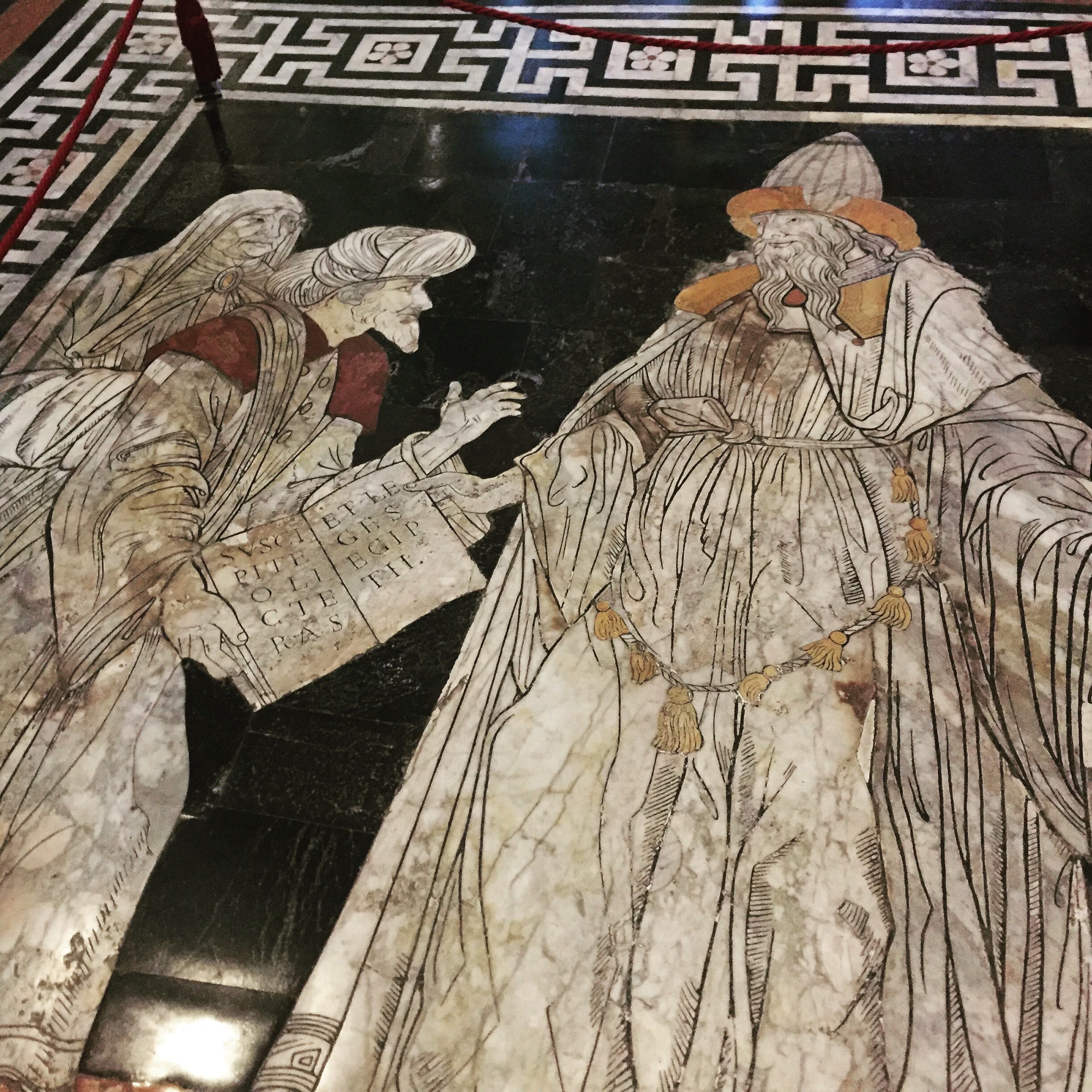
I first came across this wonderful word marvelling at the incredible floor in Sienna’s famous cathedral, where the psychopomp Hermes Trismegistus is depicted, doing a bit of editing himself by the look of it.
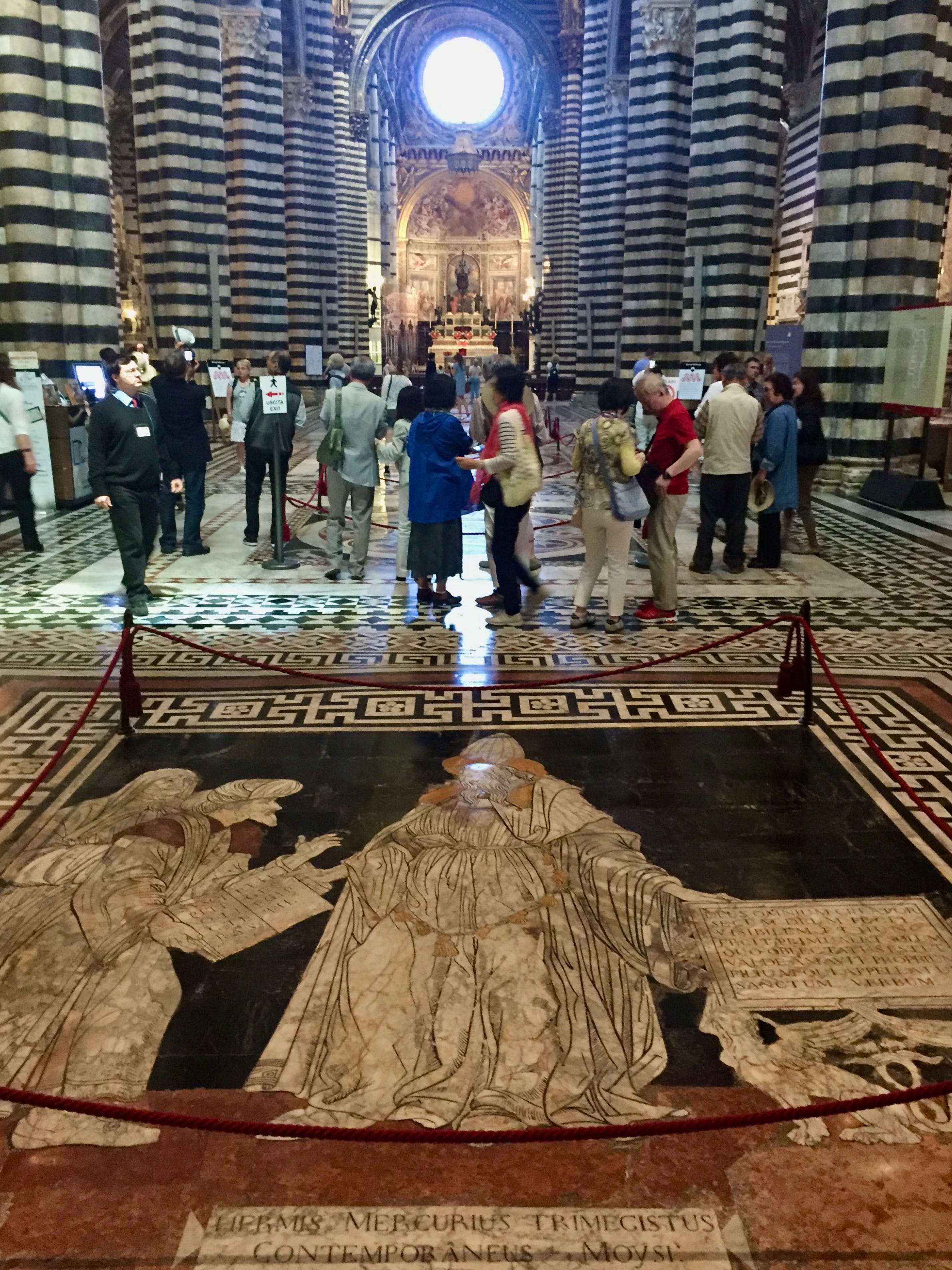
No better chap then to help me with my editing ailment problem.
Liminal playtime
As Dorothy Lehane explains in her recent fascinating post about ‘hypnopompic cognition’, it’s
a transitional period between sleep and wakefulness, where the brain exists (sometimes lingering awhile) in this unique neurological state: creative, intuitive, and unconstrained by the usual logic or critical filters.
In that state, Hermes Trismegestus or one of his ilk paid me a visit with a great idea. Let go of my dramatic precious structure. ‘Massacre your innocents’ as Herod might have said, ‘Kill your babies’ as Kipling is supposed to have said, or ‘Blow up your structure’ as Rowena Cade might have said. She much enjoyed the use of dynamite in the creative reconstruction of her theatre year on year. I suspect she wasn’t averse to a bit of hypnopompic cognition herself.
By releasing the text from a strict act and scene format, I find I have more space to introduce myself as author when creatively appropriate and more opportunity to slow down and provide more fulfilling details. So one simple idea cascades to create a solution to all my editing ailments.
The shoulders relax, the head stops spinning, the insomnia subsides and the tummy ache begins to abate.
Back to work!
I’m very grateful to @Dorothy Lehane for providing me with this term in her latest Lyrical Surgeries post – highly recommended
My friend artist Sue Ridge tells me that ancient physicians would prescribe a poem to cure ailments. Unfortunately none of mine seemed to work. A Shakespeare sonnet helped a bit.
Brighton’s former MP, Caroline Lucas, now works as an end of life doula. Not many people know that.
Thanks for the background info Wikipedia.
So much to love in this pompic post, John! I was particularly moved by your attention to process and feedback. "Almost all my readers agree these should be carefully kneaded back into the main narrative. It’s a request which neatly loops back to the problem of structure too." Also the trajectory of this! ‘Massacre your innocents’ as Herod might have said, ‘Kill your babies’ as Kipling is supposed to have said, or ‘Blow up your structure’ as Rowena Cade might have said." love it- and then there is Sir Arthur Quiller-Couch who apparently said (in his 1916 Cambridge lecture On Style): “If you here require a practical rule of me, I will present you with this: ‘Whenever you feel an impulse to perpetrate a piece of exceptionally fine writing, obey it — whole-heartedly — and delete it before sending your manuscript to press. Murder your darlings.’” Have also heard it attributed to William Faulkner...
Anyway- lovely to be in dialogue and thank you for more hypnopomp revelations! We must be in telepathic communication- I'd just written you an email maybe an hour ago!